
1. Sticky notes and lists by the door
Cheap, immediate, and it works right away. The problem shows up after a week or two: the note becomes part of the background. You've read it so many times that your eyes slide past it without the words actually registering. It still says "keys, wallet, charger," but it's stopped functioning as a reminder and started functioning as decoration.
Best for: a very short-term fix, or a list you genuinely rewrite and move every few days so it stays novel.
2. A fixed-time phone alarm
Solves the "I stopped noticing it" problem, since a phone buzzing is hard to tune out entirely. The catch is timing. Your actual leaving time isn't fixed. Set the alarm too early and it fires while you're still in the shower, so you dismiss it and forget the reminder along with it. Set it too late and you're already in the car. Most people adjust the time a few times, give up on getting it right, and quietly turn the alarm off.
Best for: mornings with a genuinely fixed schedule, like a specific bus you catch at the same time every day.
3. Moving the item somewhere you can't avoid seeing it
Hanging your keys on the door handle instead of a bowl by the entryway is a small change that works surprisingly well, because you physically have to move them to open the door. It's one of the few tricks that doesn't rely on willpower or attention at all.
The limit is that it only scales to one or two items. You can hang keys on a door handle. You can't hang a charger, a gym bag, and a work badge there too without turning your entryway into clutter, and at that point you're back to needing a system, not a single trick.
4. Asking someone else to check
A partner, roommate, or parent glancing at you on the way out catches a lot, often more than any of the other methods here, because a person can notice "you don't have your umbrella and it's raining" in a way a static list can't.
Obviously this depends on having someone else around, and it doesn't cover the trips you take alone. It's a good backup layer, not a full system on its own.
5. A reminder tied to actually leaving
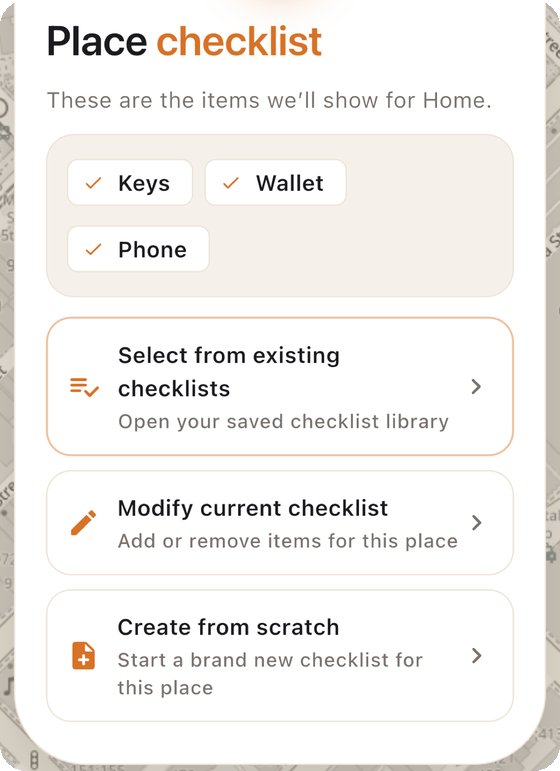
This is the one that addresses the root problem directly instead of working around it. Sticky notes fail because you stop noticing them. Alarms fail because the timing is a guess. This approach fixes both: instead of a fixed time or a static object, the reminder is tied to the event of leaving itself, so it shows up after you've actually left and nowhere else.
On a phone, this is usually done with geofencing: the OS notices when you cross a boundary around a saved place, like the edge of your yard or parking lot, and an app can react shortly after. It's the only method on this list that adapts automatically to whatever time you actually leave, rather than requiring you to guess it in advance.
The tradeoff is that it needs an app built specifically for this, since it's not something you can set up with a note or a generic alarm. The upside is that once it's set up, there's nothing left to remember. You don't have to notice a note or catch an alarm at the right time. It just shows up.
Which one is actually right for you
Realistically, most people end up combining two or three of these rather than picking just one. A doorway hook for your keys, plus something that catches everything else, covers most mornings well. The main thing worth taking away is this: if a method has been failing for you for months, it's usually not because you're not trying hard enough. It's because that particular method has a structural weak point, and no amount of willpower fixes a structural weak point. Switching to a different kind of method, not trying harder at the same one, is what actually changes the outcome.