
Almost everyone who forgets their keys, wallet, or charger on the way out isn't forgetful in general. They remember birthdays, passwords, work deadlines. The problem is narrower than that: it's remembering a small task at the one moment it matters, which is usually the most distracting moment of the whole morning.
Why "just remember" doesn't work
Psychologists call this prospective memory: remembering to do something in the future, without anyone reminding you. It's a different skill from remembering facts, and it's notoriously unreliable, especially when the moment you need to act is buried inside a routine you're already running on autopilot.
Think about what's actually happening when you leave the house. You're checking the stove, grabbing your bag, maybe herding a kid or a dog, thinking about the drive or the meeting you're walking into. The intention to grab your charger got formed an hour ago, while you were still charging your phone. By the time you're at the door, that intention has to compete with everything else going on, and it usually loses.
The checklist trap
The obvious fix is a checklist: a sticky note by the door, a note on your phone, a list taped to the wall. These genuinely help for a week or two. Then something predictable happens: the note becomes part of the scenery. You stop reading it because you've read it a hundred times already, and your brain files it under "already known" instead of "needs checking."
A checklist only works if something makes you actually look at it at the right moment. A note that's always there stops being a trigger. It becomes wallpaper.
Phone reminders have the same problem, from a different angle
Setting an alarm for "7:45am, don't forget your gym bag" solves the visibility problem but creates a timing problem. Your actual leaving time moves around: some mornings you're out the door at 7:40, others at 8:05. A fixed-time reminder either fires too early, before you've even started getting ready, or too late, after you've already left. Either way, it stops being useful, and most people turn it off within a few days.
What actually works: a reminder tied to leaving itself
The pattern that holds up is different: instead of trying to remember earlier, or trying to guess the right time, you want something that notices you've actually left and prompts you then, while turning back is still easy.
That's a harder problem than it sounds, because "leaving" isn't a fixed time, it's an event. A few approaches get closer to solving it:
- Put the item somewhere you physically cannot leave without seeing it. Hanging your keys on the door handle instead of a hook works because you have to move them to open the door. This works well for one or two things, but doesn't scale past that.
- Ask someone else to check. A partner or roommate glancing at you on the way out catches a lot. Not available for everyone, and doesn't cover every trip.
- Use something that detects when you actually leave. This is the one that scales: a reminder tied to the event itself, not a guessed time or a static note, only shows up when it's relevant.
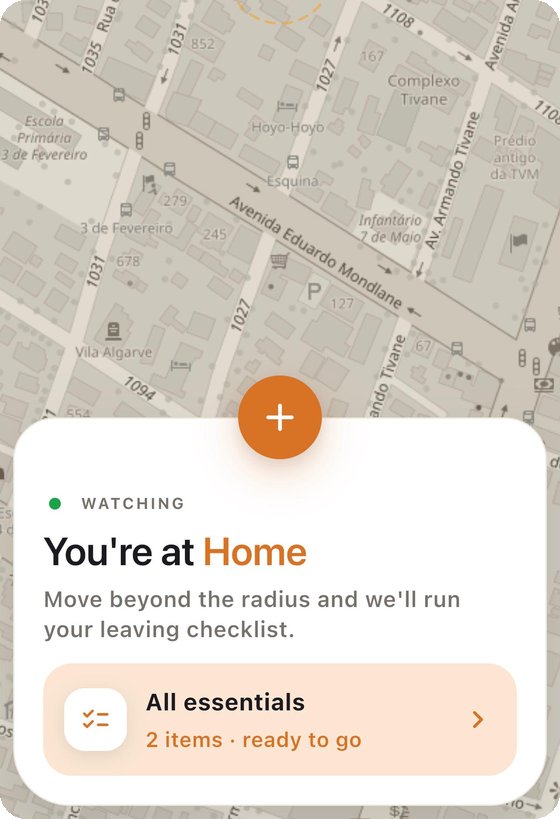
Building a leaving checklist that actually gets used
If you're building your own system rather than using an app, a few things make a real difference:
- Keep it short. Three to five items, not fifteen. A long list gets skimmed, not read.
- Make it specific to the trip. A gym checklist and a work checklist are different lists. One generic list for everything gets ignored because half of it never applies.
- Put it where the leaving actually happens, not somewhere you pass earlier. By the door beats the fridge.
- Review it occasionally. If you haven't forgotten your umbrella in six months, it's not earning its spot on the list anymore.
This is genuinely most of the way there, and for a lot of people it's enough. The remaining gap is the one from the section above: a list only helps if something makes you look at it right when you're leaving, not before and not after.